Close your eyes for a moment and imagine the deafening roar slowly fading, replaced by the nearly imperceptible hum of life-support systems. You are aboard the Orion capsule. Through the small reinforced porthole, the darkness surrounding you is not a void but a dense, velvety presence, broken only by a quality of light you have never encountered on Earth. Then, there it is: the Moon. No longer a flat silver disc in the night sky, but a three-dimensional world of titanic proportions — an expanse of dust and craters that seems to have been waiting for your gaze since the beginning of time. To photograph this moment is not merely an act of technical documentation; it is a desperate and beautiful attempt to capture the ineffable. The images of the Artemis II mission are not simple high-resolution digital files; they are new chapters in a diary humanity has been writing ever since it first raised its eyes to the sky. In this post, we explore how these visions are changing, once again, our place in the universe.
Section 1 — The Historical Context: The Pillars of Our Perception
To understand the importance of Artemis II, you must first look back. The history of space photography is, in truth, the history of our self-awareness. Three images have acted as genuine "cosmic mirrors" for our species — each one arriving at a moment when humanity needed to see itself from the outside.
The first is Earthrise (1968), taken by William Anders during Apollo 8. As the crew orbited the Moon, the Earth suddenly appeared above the lunar horizon: a fragile, vibrant blue marble against absolute nothingness. That image gave birth to the modern environmental movement, forcing the world to understand that we are all passengers aboard a finite and vulnerable "Spaceship Earth."

A few years later, in 1972, the crew of Apollo 17 gave us the Blue Marble. For the first time, the entire sunlit face of the Earth was visible in a single frame — no borders, no nations, only swirling clouds and oceans. Then, in 1990, the Voyager 1 probe turned back from six billion kilometres away to capture the Pale Blue Dot. As Carl Sagan wrote, Earth was reduced to "a mote of dust suspended in a sunbeam." These photographs did not merely document space; they humbled our ego and inspired our responsibility toward the only home we have ever known.
"Look again at that dot. That's here. That's home. That's us."
— Carl Sagan, Pale Blue Dot: A Vision of the Human Future in Space, 1994
Section 2 — The Photographs of Artemis II: Analysis of Image art002e010208
We arrive at the present. Artemis II delivers an image quality without precedent, thanks to digital sensors that far surpass the sensitivity of the Hasselblad film cameras used during the Apollo era. Examine this specific frame captured by Orion's optical navigation cameras:
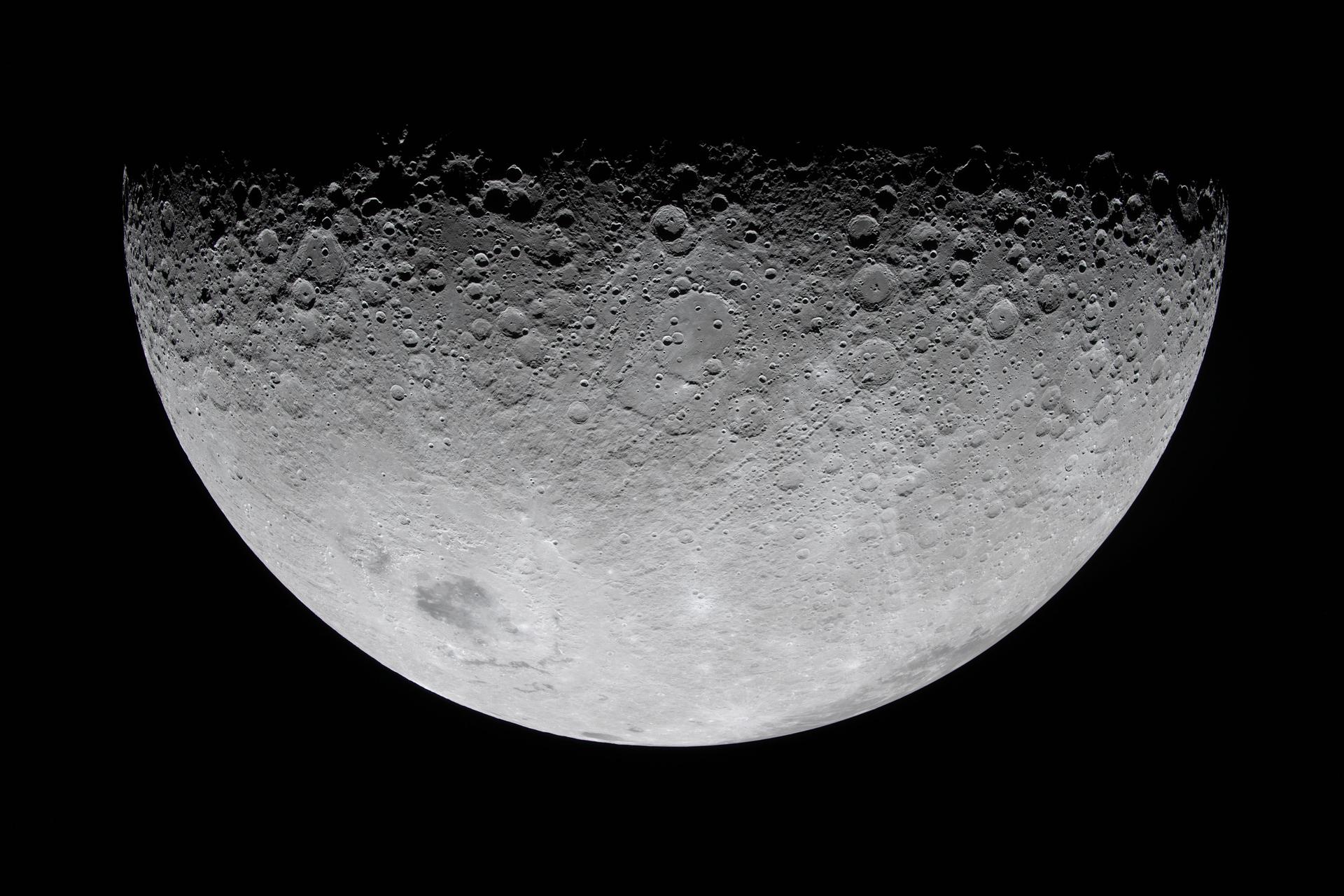
In this image, the Moon is no longer a distant destination but a material presence, almost tactile. The sharpness of surface details — small craters nested within larger ones, razor-sharp shadows cast by the absence of atmosphere — stands in deliberate contrast to the softness of the Earth blurred in the distance. It is a composition that shouts "perspective." It tells you that we have returned, but with new eyes: eyes capable of capturing the nuances of lunar dust with a precision our grandparents could only dream of. Every pixel is a data point; every shadow is a story written in silence over billions of years.
Section 3 — Why These Images Change Everything: A Prospective View
The photographs of Artemis II are not merely "more beautiful" than their predecessors; they are politically and socially revolutionary. For the first time, we will see the Moon through the eyes of a mixed crew. When Christina Koch or Victor Glover look out of that porthole, the image that emerges speaks to the whole of humanity, not just a fraction of it. This inclusivity forges a new aesthetic of exploration: no longer the solitary "conqueror," but a team representative of Earth's diversity.
The cultural impact is immense. We live in the age of instant sharing. If Apollo was documented through grainy footage transmitted with minutes of delay, Artemis II allows us to experience space in 4K resolution — vivid, immediate, almost visceral. This will transform the way the next generation — the so-called Artemis Generation — perceives science. Documentation becomes immersive. You do not simply look at a photograph; you feel yourself part of the journey. This "visual democratisation" of space accelerates scientific curiosity and inspires careers in STEM fields on a scale never seen before.
There is also a subtler shift happening. The Apollo photographs were taken in an era of geopolitical competition, where the race to the Moon was a proxy battle between superpowers. The images carried a flag — literally and symbolically. The images of Artemis II are born in a different context: international collaboration, commercial partnerships, and a stated mission to return to the Moon not just to plant a flag, but to learn how to stay. That intent is visible in how the photographs are composed, shared, and discussed. They feel less like trophies and more like dispatches from a long expedition that is only just beginning.
Section 4 — A Visual Dialogue Across Epochs
Comparing the historic shots with those of Artemis II is like observing the evolution of human thought rendered in light. Where the Apollo images carried the tone of almost mystical discovery, the current photographs have the flavour of a conscious return — we know what we are looking at, and we know why it matters.
The old photographs are saturated with the warm tones of analogue film, heavy with the grain that reminds you a human hand loaded that cartridge in a suit glove at the edge of the known world. The new images are cool, precise, technically flawless — reflecting our current reliance on digital technology to parse reality. Neither is superior; both are honest portraits of the moment that produced them.


What unites all these images — from Earthrise to the lunar limb of Artemis II — is the involuntary emotion they provoke. No caption is strictly necessary. The geometry of a small blue world against infinite darkness does something to the human nervous system that no amount of written description can replicate. It bypasses the rational mind and speaks directly to something older, something that looked up at the night sky long before we had language to describe what we saw.
Where the Blue Marble showed us who we were, Artemis II shows us where we are going. And crucially, it shows us that the journey is not reserved for a chosen few. The camera does not lie about that. Every frame transmitted from Orion is a quiet, insistent argument that the universe belongs to everyone willing to look at it with honesty and wonder.
Conclusion — To Photograph Space Is to Photograph Ourselves
Why do we keep pointing lenses into that silent void? Because photographing space is the only way we have of seeing ourselves clearly. Every Artemis II shot — every detail of the lunar surface juxtaposed against our small blue home — is a reminder: we are stardust that learned to use glass and light to admire its own origins. These photographs remind us that, despite our divisions on Earth, we are a single species bound by an inexhaustible curiosity. Looking at the Moon through Artemis II, we are not merely exploring a satellite; we are asking how far we can travel without losing sight of who we truly are. The answer, it seems, is written in every photograph we have ever taken from space. It has always been the same answer. It is us, together, small and extraordinary, suspended in the light.