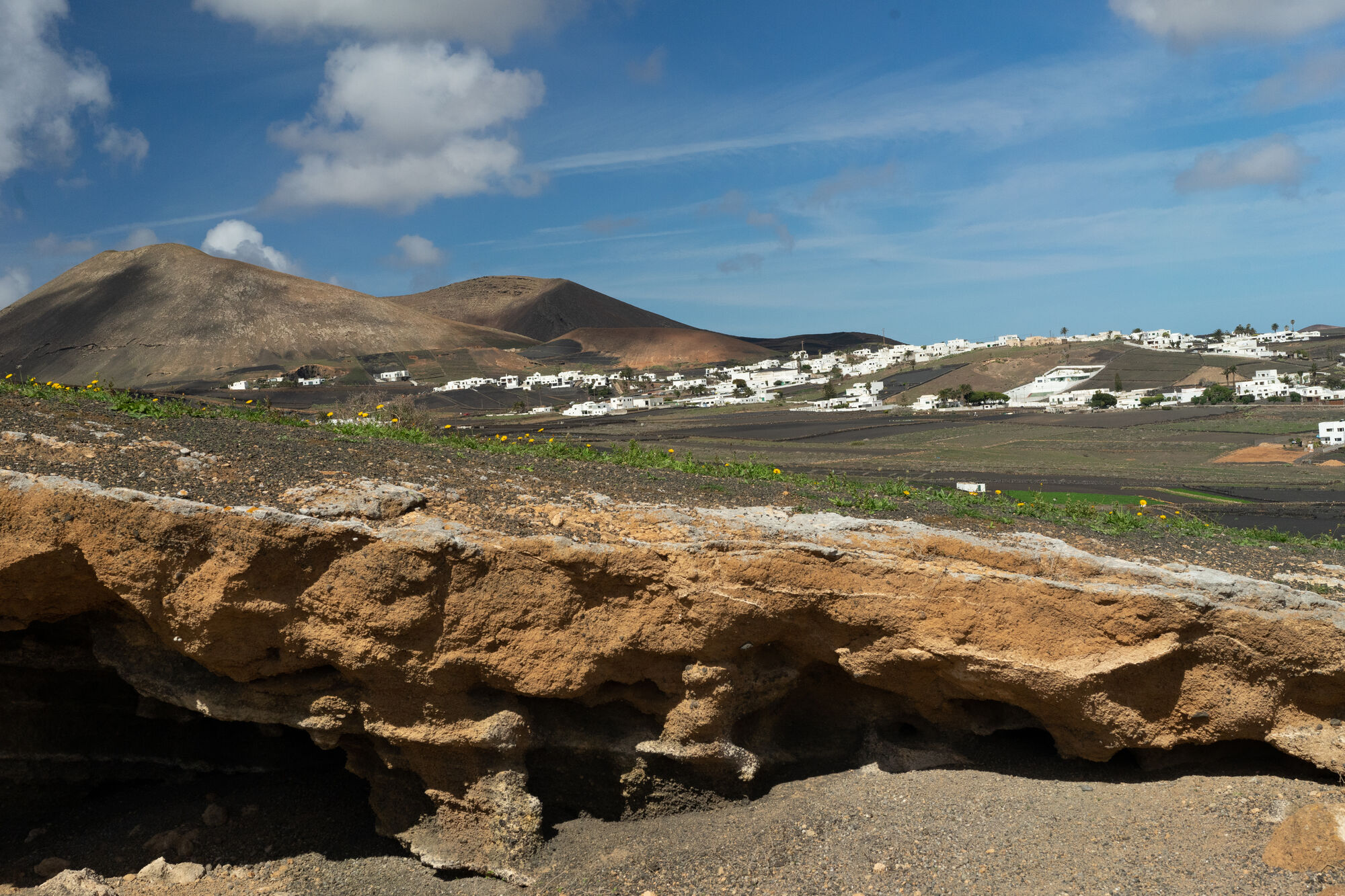
Two seismic sensors sit on bare ground in the UNESCO Global Geopark of Lanzarote. They cannot be buried and they cannot be pinned down with metal spikes, because the park forbids both. On 17 and 18 March 2025 I was on the team that moved them along 120 metres of unpaved road, 5 metres at a time, recording the ground’s ambient noise for at least twelve minutes at each stop. Now and then someone hits the road with a 4-kilogram sledgehammer.
Under that road, roughly one to three metres down, the rock stops and there is a tunnel: 1.6 kilometres long, emptied by lava during the Timanfaya eruption of 1730–1736. At stations 5 and 19 the ground behaves as ground should. At station 10, directly above the cavity, it moves up and down four times more than it moves sideways: at about 11 Hz the ratio between the two drops to 0.25. Our reading is that the roof of the cave is vibrating, like a plank.
That ringing roof is half of this post. The other half is a paste of crushed volcanic glass that has to harden in a vacuum. The two papers come from different groups and were accepted a day apart, on 9 and 10 August 2026. I am third author on both. They look unrelated. They ask the same thing from opposite ends: where do you put a roof over your head on the Moon?
Why the surface is the problem
At the lunar equator the ground swings from about 100 K to about 390 K in a single day, roughly −170 °C to +120 °C. Near the poles it stays colder, between about 50 K and 200 K. With no atmosphere, radiation at the surface exceeds 200 millisieverts a year and micrometeorites keep falling, with no air to stop them.
Inside a lava tube, one modelling study puts the temperature near 290 K, about 17 °C, and the roof gives shielding equivalent to several metres of regolith. Both are “could”, not “does”: nobody has measured either inside a lunar tube.
So there are two ways to get a roof. Find a hole that nature has already dug, or make one from the ground you are standing on. The second has an economic argument: the regolith paper cites an estimate of 20,000 to 100,000 US dollars to send one kilogram of water to the Moon. Every kilogram made from local material is a kilogram you do not pay that price for.
A tunnel that is already there
A lava tube forms when the outside of a basalt flow solidifies while the inside stays molten. The liquid keeps flowing beneath its own crust, eventually drains away, and leaves a tube. On the Moon and Mars, orbiters have photographed pits that look like tube ceilings collapsed in places. They are called skylights, and some of the lunar ones are more than 100 metres across. From orbit the information stops there. You can see the hole. You cannot see how thick the roof is, how wide the tube is, or whether it continues.
Gravity and magnetism do not help from that height either. Both weaken quickly with distance, gravity with the square and magnetism with the cube, so at orbital altitude a small tube disappears into the background. The plan is to put instruments on the ground, on a rover, and measure from there. First, you test the plan on Earth.
The Cueva de Los Naturalistas is a good rehearsal room. It is easy to reach, and it is cut in basalt not far in composition from lunar and martian mare basalts. Its cross-section is an ellipse, 1 to 8 metres high (mean 3) and 1 to 20 metres wide (mean 10); under the survey line it is about 15 metres wide. Geologists call it a shallow inflated tube: lava kept pushing in beneath a crust that had already set, and lifted it like a lid.
How wide is a tube?
-
Cueva de Los Naturalistas, the stretch under the survey line: about 15 m
-
Typical tubes on Earth: 10 to 40 m
-
Mars, from the pit chains: 40 to 400 m
-
The Moon, predicted: 500 to 600 m or more
The Naturalistas tube is small, and the paper says so. The authors expect the methods to work better on bigger tubes. That is a hypothesis, not a result. They also note that gravity and magnetic inversions tend to pull deep bodies towards the surface, so deeper tubes will be harder.
Three ways to find a hole
The team ran three kinds of measurement along the same 120-metre line: 25 stations, 5 metres apart. Each is sensitive to a different property of the rock.
Weight
A cavity is missing mass, and a gravimeter can feel that. The instrument reads to 1 microgal and is accurate to 5; a microgal is about a billionth of Earth’s gravity. Above the tube the corrected signal dips by roughly 0.15 milligal. The rock itself is light and variable: two samples averaged 1,570 kg/m³ and some measured as low as about 1,200.
Magnetism
Empty space contains no magnetic minerals, so the field dips over the tube, by close to 2,000 nT. A dip can have other causes, and the paper rules them out. Rock magnetised backwards would do it, but these lavas erupted during the current normal-polarity chron. Rock whose magnetic minerals were altered by hot fluids would do it too, but no hydrothermal activity is documented in the area.
The catch for the Moon
Neither the Moon nor Mars has a global magnetic field today. Lava that erupted after the field died carries no magnetisation to detect, so a tube in it would be invisible to a magnetometer. Gravity and seismic methods would still see it. That is one reason to use more than one method.
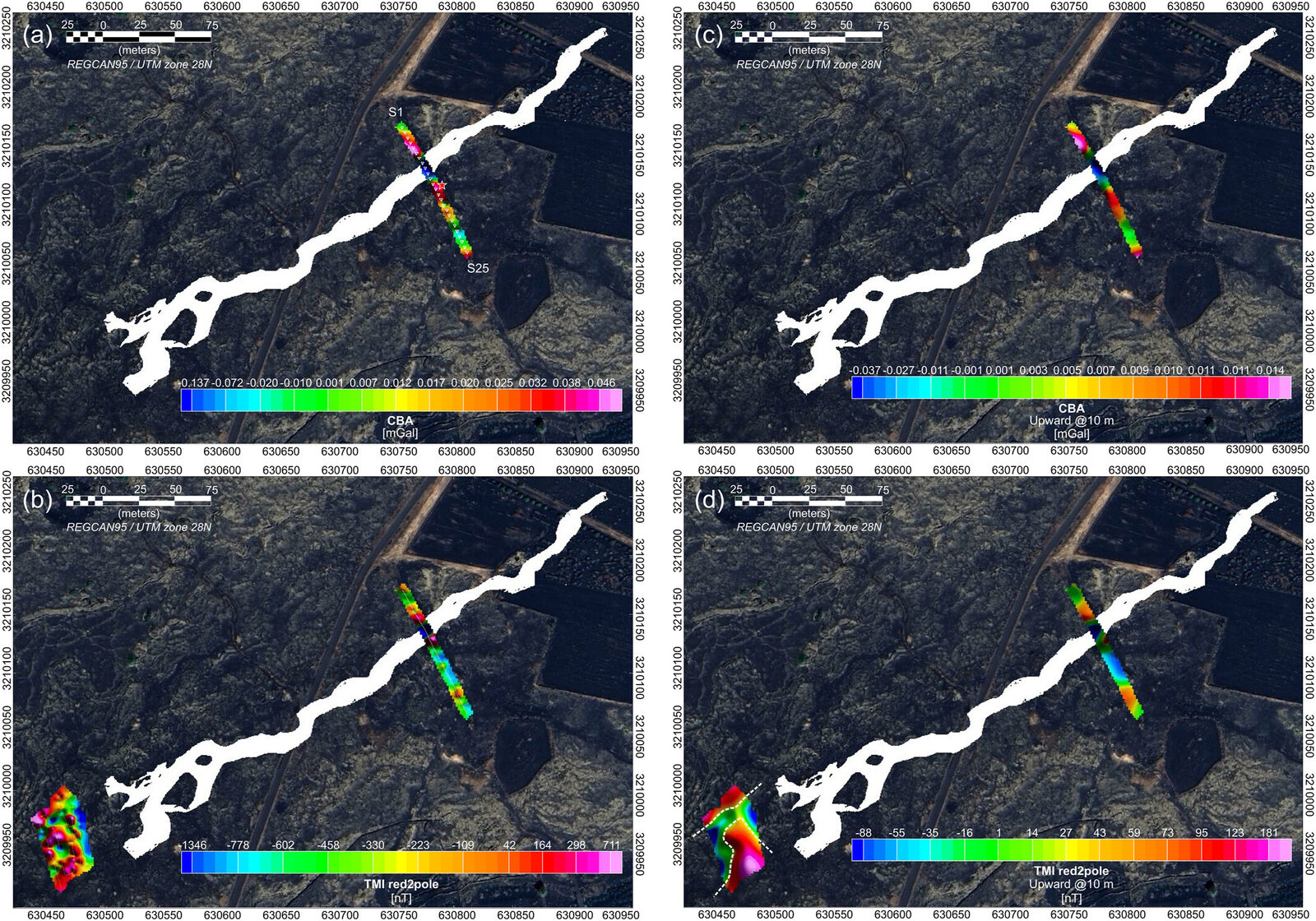
Lifting the data also isolates a second, weaker dip south of the tube on both maps. The authors read it as more likely porous rock than a second tube: the seismic data show no void signature there, and the sampled rock is that variable. The lifted magnetic map of the second area, M2, seems to follow the tube’s course, which suggests the method could trace a tube where nobody knows one exists.
Vibration
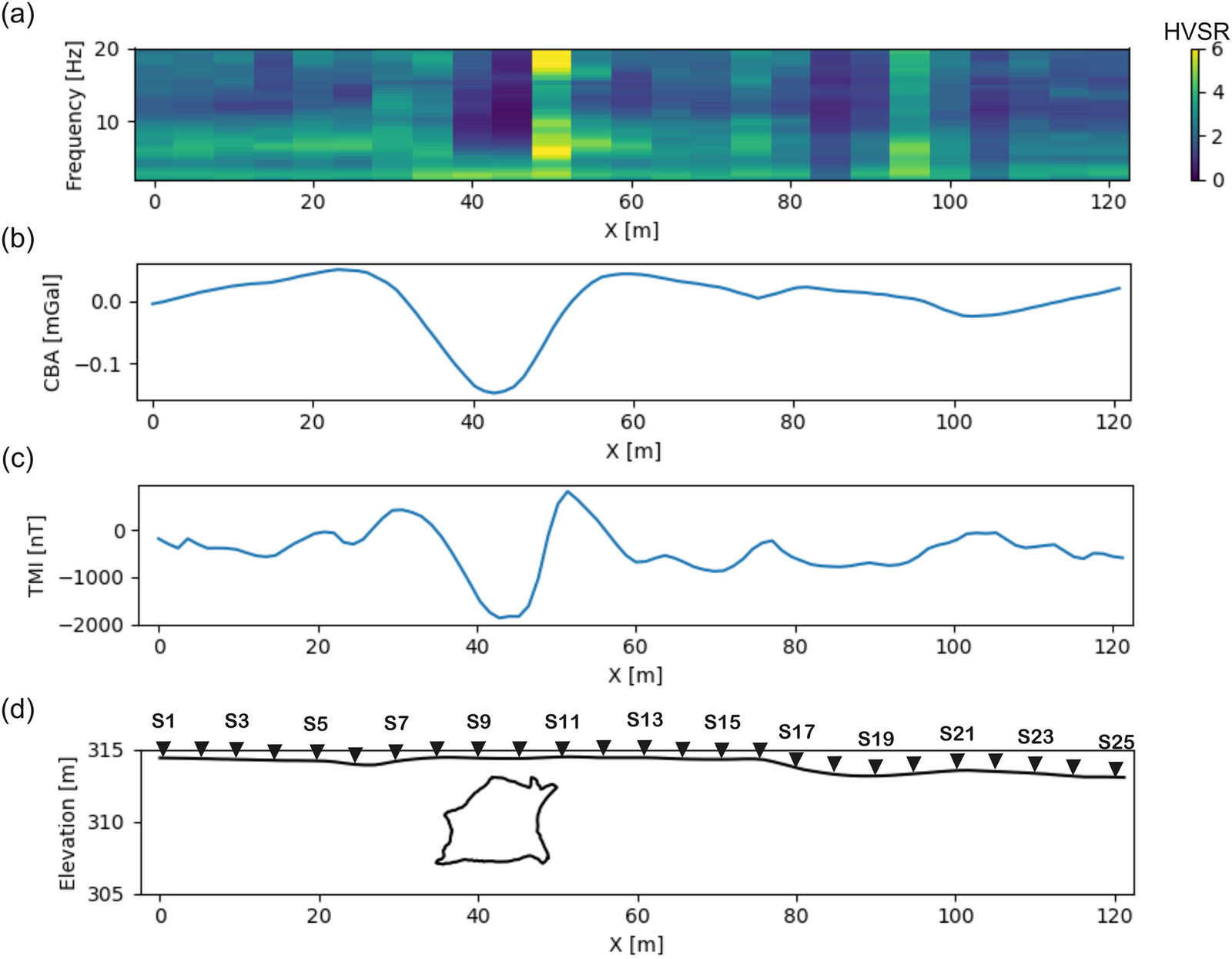
The passive seismic method is called HVSR, the horizontal-to-vertical spectral ratio. It uses ambient noise only, wind, sea and distant traffic, and compares how much the ground shakes sideways with how much it shakes up and down, frequency by frequency. Ordinary ground gives a curve with a few peaks that mark buried layers, here at about 2.5 and 6.5 Hz. Over the cavity the 2.5 Hz peak is still there, but at 11 Hz the curve falls into a trough: vertical shaking beats horizontal by four to one. Stations 9 to 11 show it, which makes a width of 15 metres. The real tube is about 15 metres wide.
Why 11 Hz? Seismic waves bouncing between the top and bottom of a 1.5-metre roof would resonate at about 150 Hz.
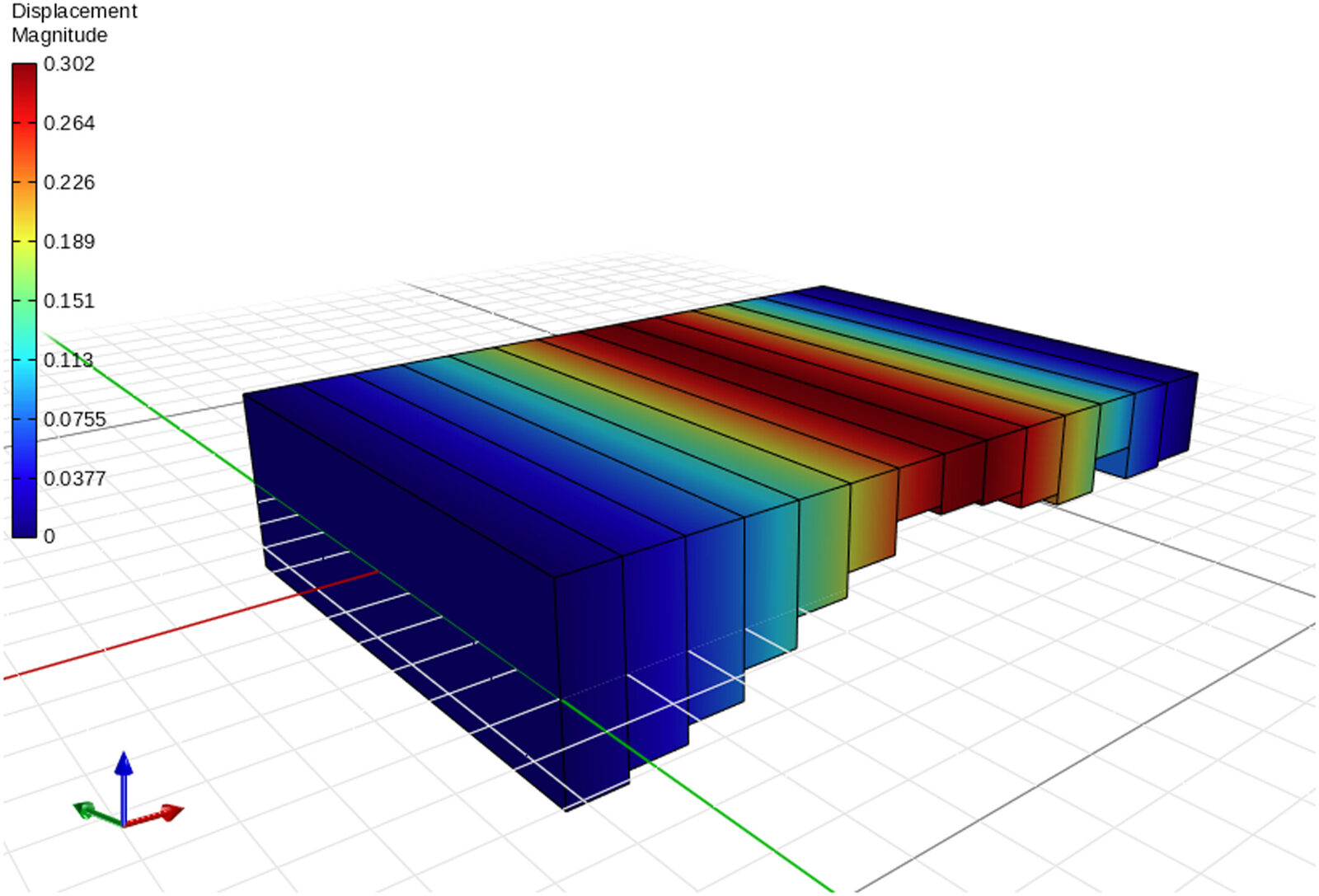
The authors’ explanation is that the roof is not ringing like a slab of rock. It flexes like a plank fixed at both ends, and a plank vibrates far more slowly. They modelled it as a fixed beam 14 metres long. With a stiffness estimated from the shallow seismic velocities, 0.314 GPa, the beam rings at 4.15 Hz. Raising the stiffness to 2.20 GPa gives 11 Hz.
A fit, not a measurement
Nobody measured the stiffness of that roof. 2.2 GPa is the value that reproduces 11 Hz, and the paper argues it is plausible for fractured, layered volcanic rock. The authors also call the uniform-beam assumption a crude simplification. If the stiffness were known independently, the same frequency could in principle give the roof thickness.
A fourth method, active seismic with the hammer, also showed clear anomalies above the cavity, but its resolution is too low to say anything quantitative. Put the other three on one axis and they agree.
Letting a computer guess the shape
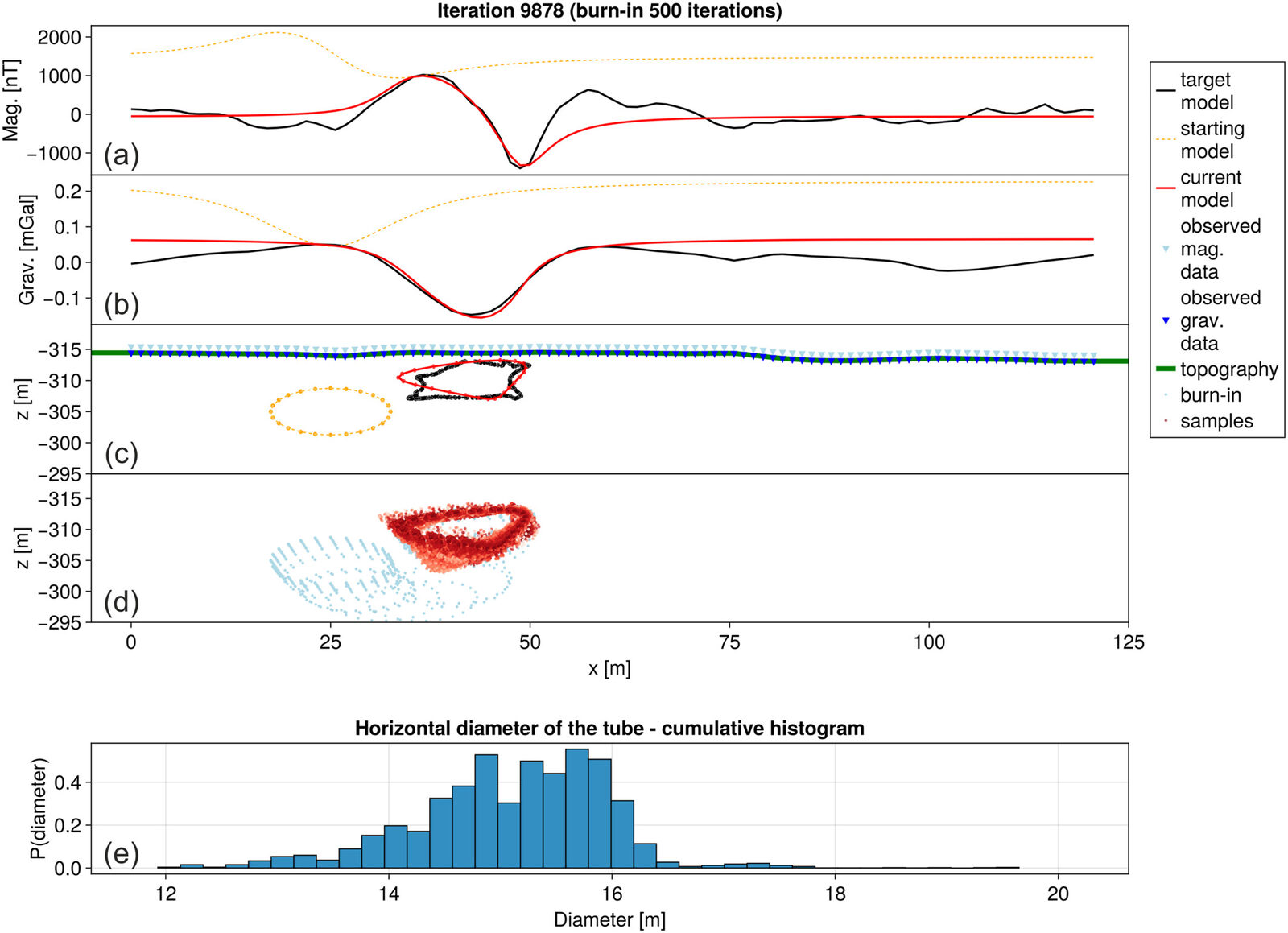
Each measurement alone fits many possible tubes. So the team let an algorithm propose them. A Hamiltonian Monte Carlo inversion explores the space of possible shapes and spends more time on those that reproduce gravity and magnetism together. Here it ran 10,000 iterations on a polygon with 24 corners, with the first 500 discarded as warm-up. The most probable horizontal diameter came out between 14 and 16 metres. The laser scan says about 15.
The probabilistic part is what matters for the Moon. You get a range of tubes and how likely each one is, not a single answer, which is what you need when nobody can check the ground truth.
What the algorithm was given
Density and magnetisation came from field and laboratory measurements on rock samples, and the starting shape was placed near the real tube. The algorithm had to find the outline, not the rock.
A cement that needs no furnace
The second paper starts with a shortage. Apollo, Luna and Chang’E have returned hundreds of kilograms of lunar soil between them, and nobody wants to grind up irreplaceable samples to test a cement. Labs work with simulants: terrestrial volcanic rock crushed to match the chemistry and grain size of the real thing. Real regolith has a median grain size of 30 to 130 micrometres.
You can turn that powder into a building material by sintering it in a furnace at 1000–1100 °C, or by mixing it with sulphur or polymer binders, or with Portland cement shipped from Earth. The paper takes another route: alkali activation. Soak the powder in a strongly alkaline liquid, the glass in it dissolves, and the dissolved material re-precipitates as a solid gel that binds the grains together. Sintering fuses with heat. This fuses with chemistry, at room temperature. It still needs water and alkali, shipped or made on the Moon.
The missing ingredient
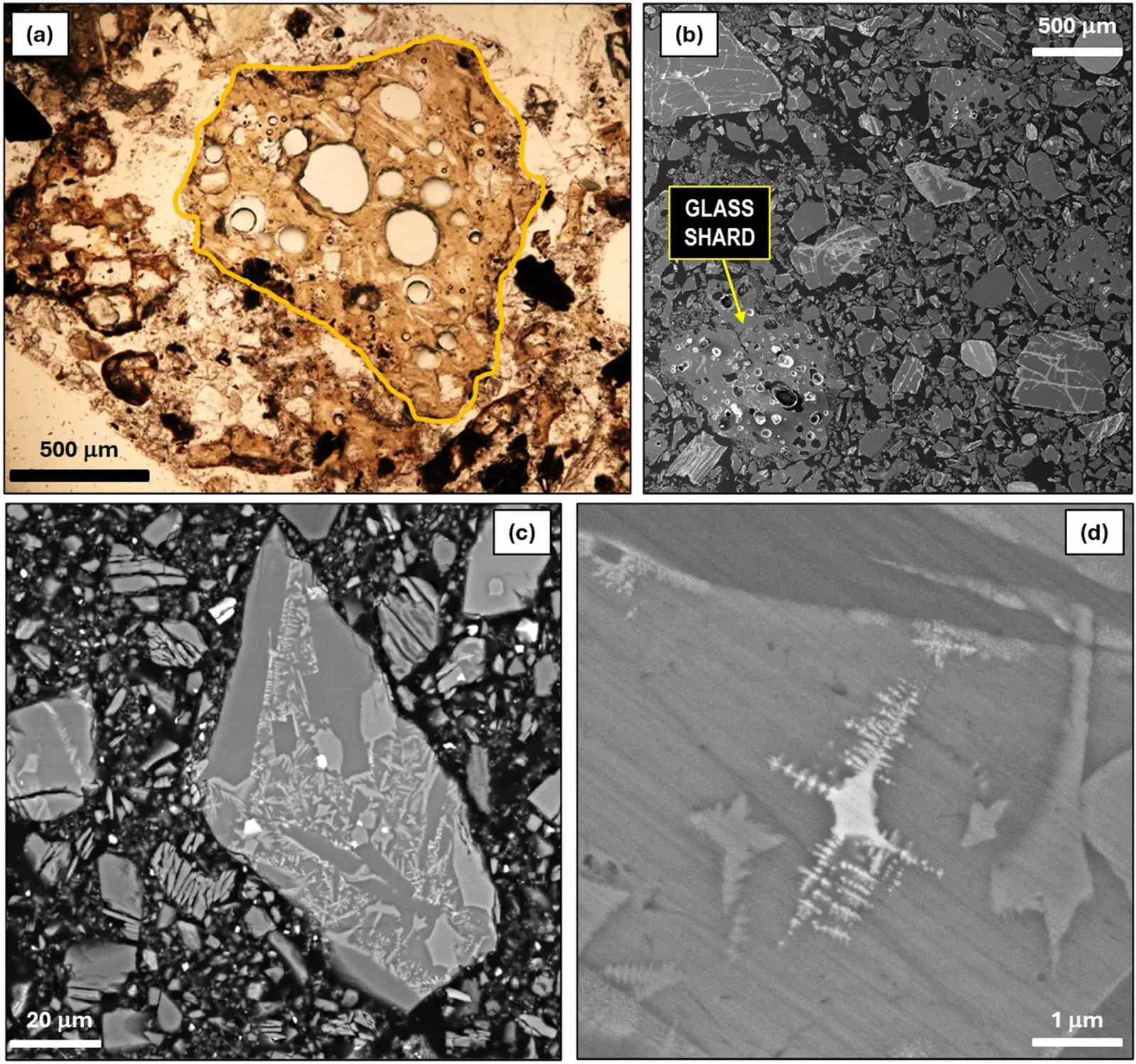
The reactive part of the powder is its glass, and the crystals mostly sit there. The simulant used for most of the work, LMS-1D, is 10 wt% glass, against 25–40 wt% in Apollo samples. Worse, the glass is short of aluminium: 0.28 aluminium atoms per silicon atom, when the binder needs between 0.32 and 0.92. Think of a recipe with one ingredient missing. Everything else is in the bowl, and it does not bind.
The experiments bear it out. In a designed set of 26 runs, in randomised order, with a sodium silicate activator, every sample with no added aluminium and cured at 40 °C or below failed to set. Cured at 60 °C for the first day, they set but stayed under 1 MPa.
A word on the unit. Strength here is compressive strength in megapascals: 1 MPa is about 10 kilograms of load on every square centimetre. Ordinary building concrete is usually in the 20–40 MPa range: Eurocode 2 (EN 1992-1-1) lists this as strength classes C20/25 to C40/50.
Fix one: bring the aluminium from Earth
Add metakaolin, a calcined clay rich in reactive aluminium. At 8.5 wt% metakaolin the 14-day strength was 31.1 MPa, at 12 wt% it was 34.2, and across the whole trial up to 15 wt% reached 44 MPa. The catch is that metakaolin does not come from the Moon. For the 8.5 wt% recipe the authors work out 61 kilograms of Earth-made material per tonne of binder if the alkaline solution can be made on the Moon, and 346 kilograms if everything except the regolith has to be shipped.
Fix two: put the aluminium in the liquid
Blend two simulants, 40% LMS-1D and 60% JSC-2A, which lifts the glass to 29 wt%, close to real Apollo samples, and activate with sodium aluminate, a liquid that carries its own aluminium. No clay. With 24 hours at 60 °C the 14-day strength averages 17.0 ± 3.1 MPa; left at ambient temperature it falls to 4.8 ± 2.7 MPa. The transport bill: nothing, if the activator can be made on site, or 231 kilograms per tonne if the aluminate and water are shipped. The authors consider about 17 MPa possibly acceptable in lunar gravity, and say a better assessment at longer curing times is needed.
Compressive strength of the pastes, MPa
- Sodium silicate plus metakaolin, clay from Earth (14 days)
-
5 wt% metakaolin13.8
-
8.5 wt% metakaolin31.1
-
12 wt% metakaolin34.2
-
Best run of the 26, up to 15 wt% metakaolin44
- No metakaolin (14 days)
-
Silicate, first day at 40 °C or belowdid not set
-
Silicate, first day at 60 °C< 1
-
Aluminate blend, ambient4.8 ± 2.7
-
Aluminate blend, first day at 60 °C17.0 ± 3.1
- Vacuum straight after mixing, then two weeks of thermal vacuum
-
Silicate, 8.5 wt% metakaolin8.5
-
Aluminate blend8.8
Then the vacuum
The lunar surface is close to a perfect vacuum, and the trouble with vacuum for a wet binder is that water wants to leave. The team tested two orders of events.
First order: let the binder harden on Earth, then move it into a thermal vacuum chamber. Four cycles between −51.0 and 101.1 °C at 0.05 Pa. Nothing degraded, visibly or in measured strength. The three silicate recipes actually came out stronger after the chamber, but that comparison mixes two ages, 14 and 28 days, and the error bars are large. The safe reading is “no damage found”, not “vacuum helps”. The cold end of the cycle is also far from a lunar night: the paper puts equatorial lows near −170 °C, and says the aim was a wide swing, not a copy of any latitude.
Second order: put the fresh paste under vacuum straight after mixing, before it has set. Here, a vacuum oven for 48 hours at 60 °C and 300 Pa, then into the same chamber. Water vapour escaped from the wet paste and left large voids that merged with one another.
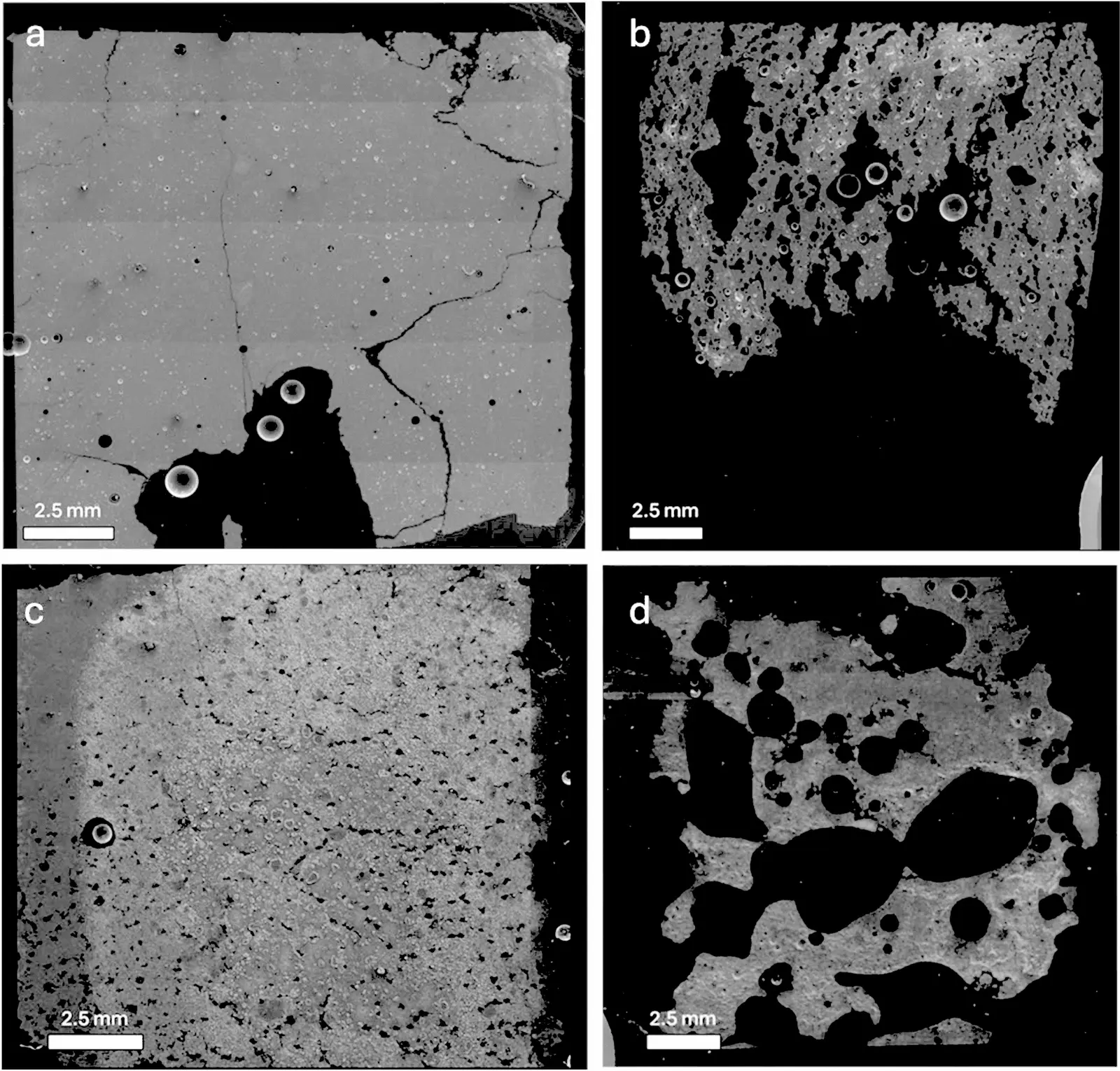
It still set. The silicate paste reached 8.5 MPa and the aluminate paste 8.8 MPa. Two different recipes ending up nearly equal suggests that once the holes are there, the holes set the strength and the chemistry matters less. Why the paste set at all is not fully explained. The authors point to three things: modelling suggests the binder starts forming within seconds of mixing, with a significant amount there after 30 minutes; this binder holds little water compared with Portland cement; and the oven’s vacuum was milder than the Moon’s, so some binder may have formed before the water left.
What neither paper can tell you yet
For the tube: one tube, one 120-metre profile, and a roof stiffness tuned to reproduce the 11 Hz it was meant to explain. How the HVSR trough behaves over other shapes and depths is an open question in the paper’s own words. On the Moon a spring gravimeter also has to cope with a day–night swing of about 300 K at the equator, a problem the paper discusses.
For the cement: the powders are simulants, not lunar soil; the oven’s vacuum was mild next to the Moon’s; and the paste could never be mixed inside a vacuum, which is the test that would settle it. The aluminate route is known at 14 days only. If a paste cannot be poured outdoors, the paper’s fallback is to cast pieces indoors, in a pressurised room, and carry them out.
Two missions are being planned to visit lunar pits from the surface: LunarLeaper, a small legged robot, and Leto. Until one of them lands, the rehearsal is what there is: a tunnel in Lanzarote and a handful of small prisms of hardened paste that spent two weeks in a vacuum chamber.
Papers
- Ghirotto, A., Barone, I., Santoro De Vico, F., Melchiori, G., Zunino, A., Armadillo, E., Mittelholz, A., Sauro, F., Massironi, M. (2026). Coupling seismic, gravity and magnetic surveys for the investigation of planetary lava tubes: a terrestrial analog case study in Lanzarote (Spain). Journal of Geophysical Research: Planets, 131, e2026JE009802.
- Driouich, A., Goudarzi, A., Santoro, F., Dalconi, M. C., Dau, M., Bettanini, C., Pilehvar, S., Valentini, L. (2026). Role of amorphous phase, temperature fluctuations, and vacuum, on the performance of alkali-activated lunar regolith simulants. Materials and Structures, 59:349.
Images and numbers
Figures are reproduced from the two papers, both open access, and credited under each one. Every number in the text, including the lunar temperatures, radiation dose, water-cost estimate and tube widths, is quoted from the two papers and their references. The 20–40 MPa band for ordinary concrete is added for scale, from Eurocode 2 (EN 1992-1-1) strength classes C20/25-C40/50.